
7-Day Baa Atoll Manta Season Itinerary
A week on Dharavandhoo in the southwest monsoon, with three chances at Hanifaru Bay’s snorkel-only manta feeding site and a weather buffer.
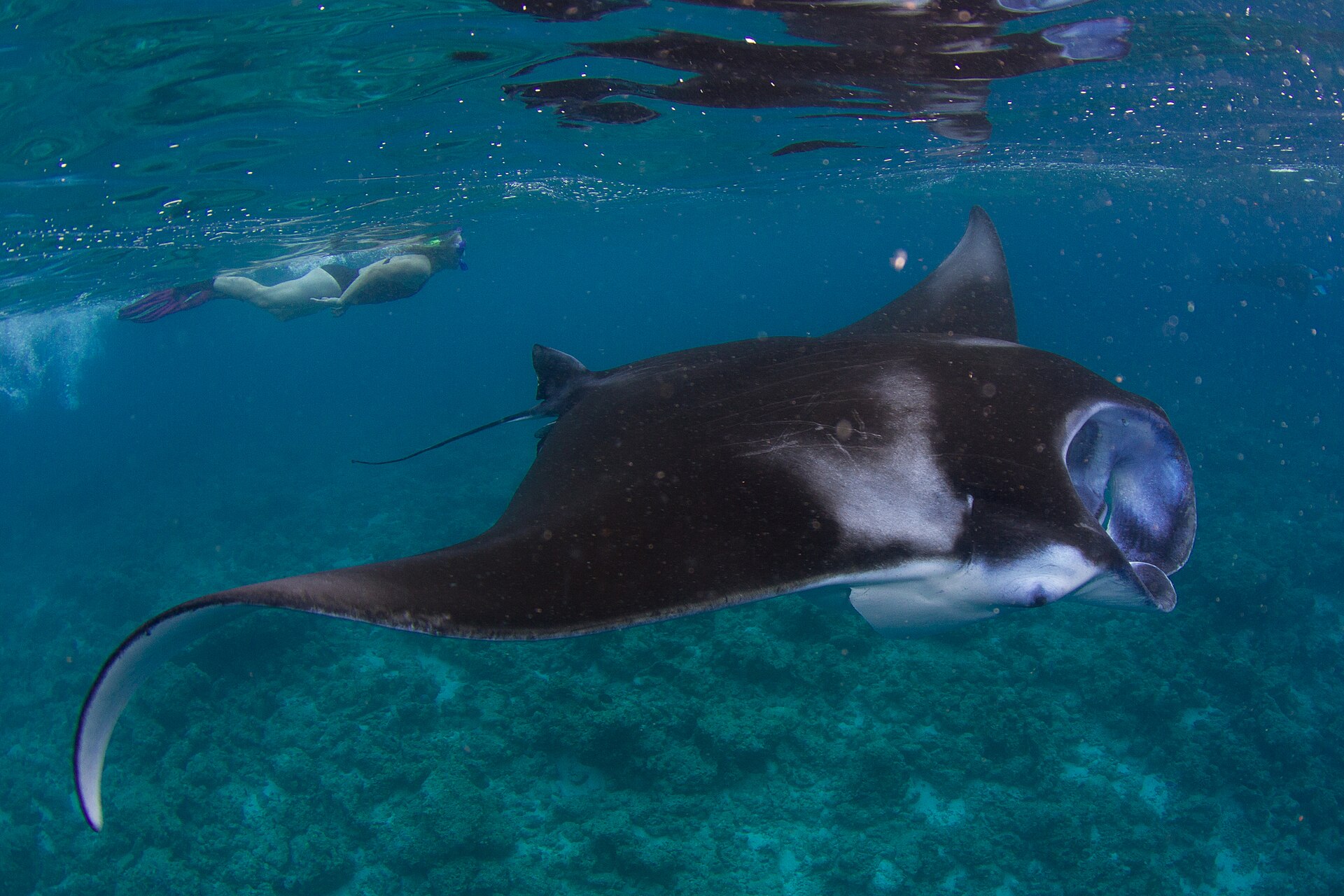
Photo: Tchami, CC BY-SA 2.0, via Wikimedia Commons
This seven-day route is built around one place and one season: Hanifaru Bay in Baa Atoll during the southwest monsoon, when plankton gathers in the bay and manta rays, and sometimes whale sharks, come in to feed. It bases you on Dharavandhoo, the local island beside the bay and home to Baa’s domestic airport, and gives you several chances at the bay instead of one.
It assumes a domestic flight between Velana and Dharavandhoo, which is how most independent travellers reach Baa. Seaplanes serve Baa’s resort islands and are covered under alternatives. Within Baa, you will travel by the boats your guesthouse or excursion operator arranges, and by the Raajje Transport Link ferries that now serve the atoll, if their schedules suit.
In this itinerary guide
- Before you commit
- Transfers, honestly
- The shape of this itinerary
- Day 1 — Arrive in Hulhumalé
- Day 2 — Fly to Dharavandhoo
- Days 3–5 — Hanifaru Bay and Baa’s reefs
- Day 6 — Buffer day or Goidhoo
- Day 7 — Return to Malé
- Alternatives and swaps
- Planning notes
- Destination guides
- Where to go next
- Read next
- Official sources
Before you commit: what this route is not
It is not a guaranteed manta encounter. Hanifaru is a small bay whose feeding events depend on plankton, currents, tides and the moon. Visit Maldives gives the season as May to November; the CMS factsheet on the bay gives May to December. Neither can tell you whether mantas will be there on the morning you go. That is why this plan gives you three days at the bay and a buffer day, and why you should not travel to Baa for Hanifaru alone outside the season.
It is also not a diving trip to the bay itself. Scuba diving is prohibited in Hanifaru; visits are snorkel-only, with limits on vessels and people in the bay at one time. Divers can dive elsewhere in Baa, including protected sites, but the famous feeding aggregations are seen from the surface. Dharavandhoo is an inhabited local island, so resort-style drinking and dress do not apply.
Transfers, honestly
Exact transfer times depend on operator schedules and weather. This guide does not quote flight or boat durations or frequencies. As checked September 2026, Maldivian and Manta Air are both listed as flying between Velana and Dharavandhoo; check current schedules with the airlines or your guesthouse.
Seaplanes in the Maldives operate in daylight only, so resort guests arriving late may need a night near the airport. Raajje Transport Link ferry services were inaugurated in Baa in August 2025 and are booked through the RTL website and app; check whether a route suits your plans before relying on it.
The domestic flight is the fixed point of this itinerary, and baggage allowances on domestic flights can be lower than on your international ticket. Check the allowance before you pack fins, a camera housing or dive kit, and ask whether your international and domestic flights can be booked together; if they are separate tickets, a delay on the first will not automatically protect the second.
The shape of this itinerary
- Night 1: Hulhumalé & Airport — rest before the domestic flight.
- Nights 2–6: Dharavandhoo — five nights beside Hanifaru Bay, with three bay attempts and one buffer.
- Optional: a day trip to Goidhoo Atoll or another Baa island if the bay has delivered early.
- Day 7: fly back to Velana for your international departure, with a margin.
Day 1 — Arrive in Hulhumalé
Sleep near the airport on the first night. Domestic flights to Baa run from Velana, and a night in Hulhumalé turns a long-haul delay into an inconvenience rather than a lost booking. If you land early and have a domestic connection confirmed the same day, you can skip this night, but only with enough time between flights to recover from a delay.
Day 2 — Fly to Dharavandhoo
Fly to Dharavandhoo and settle in. Dharavandhoo’s airport opened in 2012, and the island’s guesthouses are set up for Hanifaru visitors, so most can book bay trips, reef snorkelling and dives for you. Use the afternoon to confirm how bay visits are being organised this season, how early boats leave, and how the operator decides whether conditions are worth going out for.
Walk the village in the evening with shoulders and knees covered. Baa is a UNESCO Biosphere Reserve, designated in 2011, and the reserve includes inhabited islands as well as reefs; the conservation story here is also a local livelihood story, with tourism and fishing central to the atoll economy.
Days 3–5 — Hanifaru Bay and Baa’s reefs
Plan one bay visit for each of these days, and make the rest of the day flexible. If mantas are feeding, a single visit can be enough, and you can use the remaining days for other reefs. If they are not, you still have two more chances. Most operators have a feel for when feeding is likely; ask how they judge it and whether they will refund or rebook if a trip is cut short.
How Hanifaru visits work
The CMS factsheet describes the management model: snorkelling only, a cap on the number of vessels and people in the bay at once, time limits per group, certified guides in the water and rangers on site checking permits. A conservation fee is charged by the Baa Atoll Biosphere Reserve Office; in August 2025 the fee was reported at USD 10–20 per tourist (as checked September 2026). Ask your operator what the fee is this season and whether it is included in the trip price.
Follow the guide’s briefing. Manta Trust guidance is to keep at least three metres away, approach from the side, never dive down in front of feeding mantas, and avoid splashing, touching or chasing. Whale shark rules in the Maldives are three metres from the head and body and four from the tail, with no touching and no flash photography. Only experienced snorkellers should free-dive near mantas.
Beyond the bay
Baa has many protected sites besides Hanifaru, several of them designated between 1999 and 2011. Divers can join boat dives from Dharavandhoo to reefs and channels in the atoll, and snorkellers can visit house reefs and sandbanks. Thulhaadhoo, another inhabited Baa island, has a long tradition of lacquerwork; ask locally whether a visit can be arranged. See our diving trips and snorkelling tours guides for what to ask an operator.

Day 6 — Buffer day or Goidhoo
Keep day 6 as your spare bay day. If Hanifaru has already delivered, consider a day trip to Goidhoo Atoll, a small separate atoll in Baa with three inhabited islands, Goidhoo, Fehendhoo and Fulhadhoo, and an unusually open inner lagoon. Whether a day trip is possible depends on boats and the sea; your guesthouse will know. Otherwise, rest, snorkel from the tourist beach and dry your gear for the flight.
If day 6 is a Friday, expect fewer services, shops closing around prayers and possibly no public ferry. A bay visit may still run through a private operator, but confirm the day before.
Day 7 — Return to Malé
Fly back to Velana with a real margin before your international flight. Domestic schedules can change and weather occasionally affects small aircraft. If your international flight leaves early, fly back on day 6 and sleep in Hulhumalé instead; if the risk of a missed connection worries you, that is the safer choice in any case.
Alternatives and swaps
- Resort base: stay at one of the Baa Atoll Resort Islands instead; resorts arrange seaplane transfers and many sell Hanifaru trips, subject to the same bay rules.
- Add Raa: with more time, the Raa Atoll Resort Islands lie to the north, with their own transfer arrangements.
- Split with Goidhoo: spend two nights on Goidhoo Atoll after Dharavandhoo, if boat connections work for your dates.
- Outside the season: Visit Maldives says that in the northeast monsoon Ari’s mantas are more often on the atoll’s western side, so the 10-day Ari Atoll itinerary may suit better.
Planning notes
- Weather trade-off: the manta season coincides with the southwest monsoon (Hulhangu), which the Maldives Meteorological Service describes as broadly May to November and associated with rougher seas. Expect some rain and some lost boat days.
- Moon and tide: operators often plan bay visits around tides and lunar phases; ask how yours decides.
- Water safety: the UK government warns of strong tidal currents; follow your guide and use a buoyancy aid if you are not a confident swimmer.
- Etiquette: Dharavandhoo is a local island: modest dress off the tourist beach, no alcohol, respect for prayer times.
- Photography: no flash with mantas or whale sharks, and no drones over the bay unless you have confirmed they are permitted.
Destination guides for this itinerary
- Hulhumalé & Airport
- Dharavandhoo
- Goidhoo Atoll
- Baa Atoll Resort Islands
- Raa Atoll Resort Islands
- Baa & Raa Atolls region guide
Where to go next
Read next
- Where to stay in Baa and Raa Atolls
- Maldives snorkelling tours
- Getting around the Maldives
- Maldives tours and excursions
- Maldives travel planning
- All Maldives itineraries
Official sources
Transfer schedules, fees, entry rules and island regulations change; check the official source before you travel. Hanifaru rules and fees are set by the Baa Atoll Biosphere Reserve Office and have changed before, so confirm them with your operator for the season you travel.
- UNESCO — Baa Atoll Biosphere Reserve
- CMS — Hanifaru Bay elasmobranch tourism factsheet
- Edition.mv — Hanifaru management and visitor fees (Aug 2025)
- Visit Maldives — Whale sharks and mantas: where to find them
- Visit Maldives — Swimming with mantas
- Manta Trust — Evidence-based code of conduct for manta interactions
- EPA Maldives — Protected Areas of Maldives (2019)
- Wikipedia — Dharavandhoo Airport
- Runway Girl Network — seaplane and resort transfer operations
- Raajje Transport Link (MTCC) — ferry tickets and schedules
- Edition.mv — RTL ferry service launches in Baa Atoll (Aug 2025)
- GOV.UK — Maldives travel advice: safety and security
- Maldives Meteorological Service
- Atoll Times — MET confirms southwest monsoon (May 2026)
- Wikipedia — Baa Atoll
- Wikipedia — Goidhoo (Baa Atoll)